Blackstone's 2026 outlook will shape LP conversations this year. Here's what to extract and where the data deserves scrutiny.
Feb 13, 2026, 12:00 AM
Written by:
Niko Ludwig

Table of Contents
Key Takeaways:
Allocators may cite Blackstone's data. Know which figures your LPs are anchoring to before diligence begins.
CRE recovery needs qualifying. Appreciation is flat; income is doing the work. Sector-specific positioning matters.
Credit sets the benchmark. Equity managers must articulate why their returns justify the illiquidity premium over 9.6%.
Blackstone's 2026 Investment Perspectives landed on allocator desks with the weight you'd expect from the world's largest alternative asset manager. The 18-page report covers everything from AI-driven CapEx to CRE recovery timing, private credit resilience, and consumer bifurcation. But not all the data will hold up under scrutiny. Here's what fund managers should extract for positioning and where the evidence deserves a closer look.
The data breaks along three lines: commercial real estate recovery, the benchmarking pressure private credit puts on equity strategies, and structural shifts in how LP portfolios are being constructed.
When a manager with $1T+ in AUM publishes portfolio-level data covering more than 270 companies and 13,000 real estate assets, those figures circulate through investment committees and quietly set the benchmarks smaller managers are measured against.
Blackstone's 2026 outlook organizes around five macro themes:
AI infrastructure spending
Bifurcated economic growth
A cooling labor market
Moderating inflation
A declining cost of capital
Fund managers who haven't linked these data points to their own positioning will feel it in diligence. You don't need to adopt Blackstone's view, but you do need to know which numbers your allocators are anchoring to.
The CRE recovery narrative is getting louder. Blackstone's version is among the most confident:
Financing costs down roughly 40% from peak
Multifamily starts down 62%
Compelling on the surface, but the underlying data tells a more nuanced story.
The NCREIF Property Index returned 1.2% in Q3 2025, with just 0.1% appreciation. Trailing-year appreciation totaled negative 0.1%, while income yields held steady near 4.8%. The recovery runs on cash yield, not capital gains, and "why this vintage?" will come up.
Allocators will want sector-specific supply data and a clear thesis on where appreciation emerges. The 62% collapse in multifamily starts tells a fundamentally different story than office, where remote work and tenant consolidation continue to weigh on demand.

How consumer bifurcation reshapes diligence
Which side of the income spectrum does your portfolio serve? Blackstone's 2026 data makes that harder to sidestep, and allocators will use it to pressure-test tenant credit quality and revenue concentration.
Luxury hotel RevPAR grew 5.2% while economy hotels fell 3.7% (STR)
The top 40% of earners now drive roughly three-quarters of consumer spending (BLS/BEA)
Corporate interest expense sits at a 50-year low of 3.8% of revenue
Wage growth has cooled from 5.3% to 2.9%
Stronger margins, but built partly on weaker spending power at the lower end. Expect pointed questions in diligence about tenant credit quality, consumer segment exposure, and revenue concentration. If your fund is tilted toward value-segment consumers or budget-oriented tenants, your materials need to address how that exposure holds up.
Managers whose portfolios skew toward premium segments or are insulated from discretionary spending (essential services, healthcare, logistics) have a cleaner conversation.
Private credit's track record and the benchmarking pressure on equity
Private credit's track record is now the bar equity managers are measured against. Blackstone's data makes that comparison explicit:
Positive returns during all three S&P 500 downturns since 2008
9.6% annualized return over 20 years
LTV ratios roughly 50% below late-1990s levels
Opportunity set expanding from $2T in direct lending to a $30T+ addressable market across asset-backed finance, infrastructure credit, and investment-grade private placements
If your net returns don't clearly exceed that 9.6% benchmark, your deck should explain why the illiquidity premium and J-curve are justified through growth, multiple expansion, or structural advantages credit can't replicate. Allocators are comparing across the capital structure in ways they didn't five years ago.
One caveat: Blackstone's EBITDA growth data (companies above $100M growing five times faster than those below $50M, per Lincoln International) comes from a proprietary database readers can't independently verify.
Structural shifts reshaping LP portfolio construction
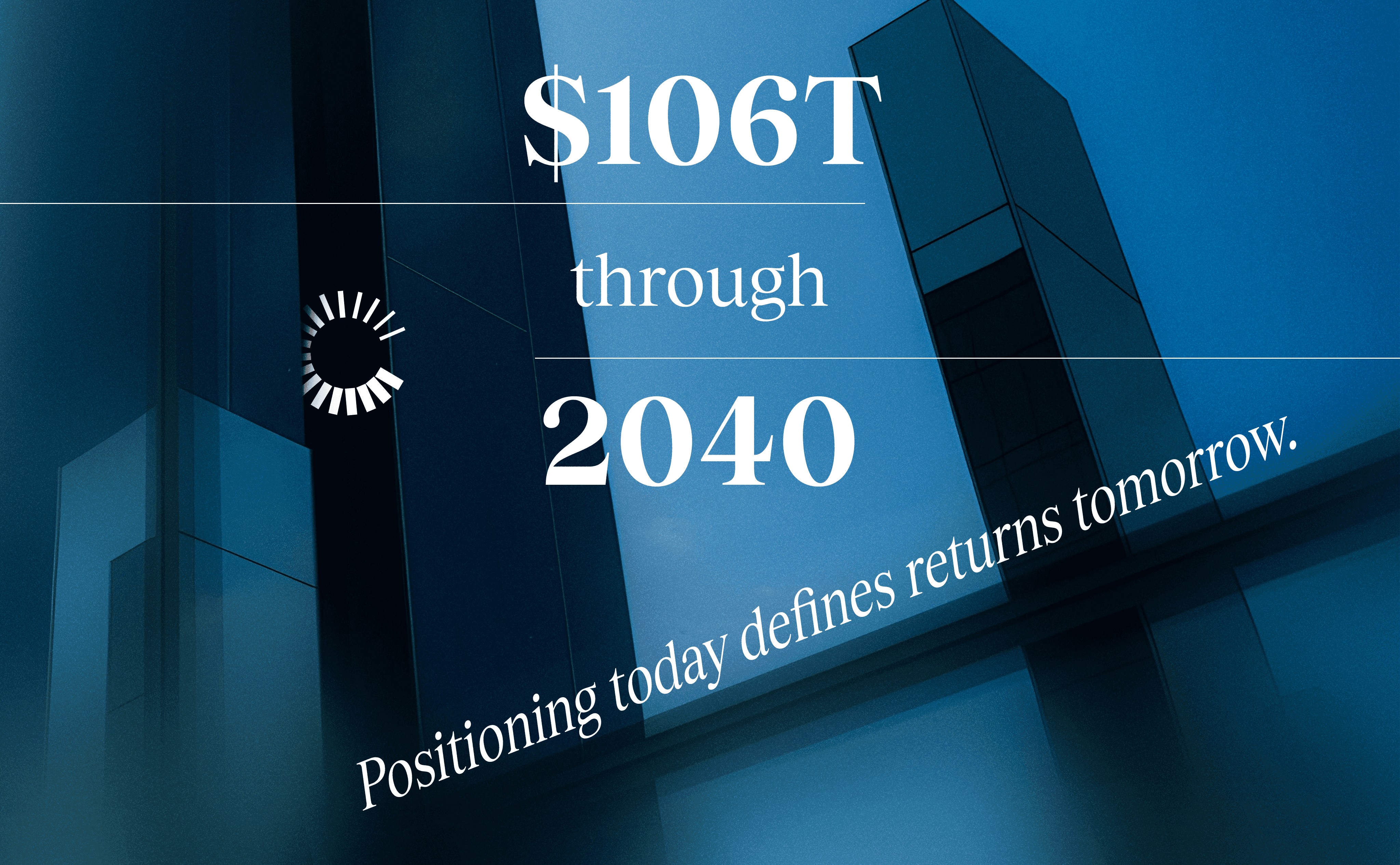
Allocators don't need convincing that public markets have narrowed—they need somewhere to redeploy. McKinsey estimates $106T in global infrastructure investment is needed through 2040, and Blackstone's data highlights a bottleneck: data center timeline-to-power has stretched from one year to more than seven.
For managers outside dedicated infrastructure strategies, the spillover matters more than the headline. Data center demand is a real estate play. Energy transition spending reshapes construction costs. Infrastructure-linked asset-backed finance is expanding the private credit opportunity set. And as infrastructure absorbs a growing share of LP portfolios, strategies competing primarily on yield may face tighter allocations.
Where Blackstone's optimism deserves scrutiny
Any analysis of a manager's public research should note where the evidence is strong and where it warrants a second look.
CRE appreciation remains elusive. Blackstone's narrative leans on historical precedent and favorable supply dynamics, but the current recovery is measurably income-driven, with appreciation through Q3 2025 essentially flat. Managers should qualify recovery language accordingly.
Private credit at scale is untested in stress. The 9.6% 20-year return comes from a period when private credit was smaller and more selective. With direct lending AUM now exceeding $2T and the opportunity set expanding rapidly, the next downturn will test the asset class at a fundamentally different scale.
Source independence matters. Blackstone's macro evidence draws partly on proprietary data (CEO surveys, internal inflation estimates, deployment figures). The K-shaped consumer and credit benchmarks use independently verifiable sources (BLS, BEA, Cliffwater, Morningstar). Claims about margin expansion and hiring trends within Blackstone's portfolio are harder to generalize.

What this means for fund managers
The fund managers who navigate this well will do two things: address the data points directly and show where the evidence holds up versus where it doesn't. That means:
Preparing for the specific diligence questions Blackstone's macro themes will generate
Reviewing your materials for gaps in how you address CRE timing, consumer exposure, and credit benchmarking
Making the case for why your returns justify the illiquidity premium over private credit's 9.6% bar
Using structural shifts to frame your specific strategy, not as a generic case for alternatives
Bottom line
Most of these data points will appear in competing decks within months. The supply collapse figures are already circulating in real estate presentations, the 9.6% return is becoming the default credit benchmark, and public market concentration data is showing up across equity pitches.
Once the same macro signals frame every strategy, the managers who stand out will be those who go one layer deeper: showing allocators how those signals specifically affect their portfolio, their sector, and their hold-period assumptions in ways that generic framing can't.
The window for getting ahead of that convergence is now, not after the first round of 2026 fundraising decks all start to look the same.
If your investor materials don't yet reflect the macro signals shaping LP expectations in 2026, Collateral Partners can help you close that gap. We work with fund managers to translate complex strategy into clear, investor-ready positioning that holds up under allocator scrutiny.










Frequently Asked Questions